
You have been unwell for months, maybe years. You have seen the GP, been referred to specialists, and tried more than one practitioner. You have had the bloods, the scans, perhaps a scope or two. The results come back normal, or they show something small that does not explain how you feel. You leave each appointment with a vague label, a referral to someone else, or the suggestion that it might be stress.
It is not in your head. A mystery illness is rarely a mystery once the right questions are asked in the right order. In my experience it is almost never one rare disease waiting to be found. It is usually several common, findable problems stacked on top of each other, each one too small to flag on a standard test, together enough to make you genuinely sick.
These are the cases I have spent more than a decade working on. Many of the people I see had already been through the system without answers before we met.
Does this sound like you?
A mystery illness looks different in every person, but the pattern around it is remarkably consistent:
- Symptoms across several body systems at once: fatigue, brain fog, gut issues, pain, skin reactions, poor sleep, anxiety or low mood
- Symptoms that move around, come in waves, or change over time
- New sensitivities to foods, chemicals, smells, medications or supplements that you used to tolerate
- A clear before and after: an illness, a move, a renovation, a pregnancy, a period of extreme stress
- Plenty of testing, mostly normal results, and no diagnosis that explains the whole picture
- Treatments that helped for a few weeks and then stopped working, or made you worse
- A growing sense that you are on your own with it
If three or more of these fit, the problem is unlikely to be any single condition. It is more likely a set of drivers that nobody has looked at together.
Why it gets missed
The medical system is built to find disease, one organ at a time. That works brilliantly for a heart attack or a broken bone. It works poorly for someone whose gut, immune system, nervous system and hormones are all slightly off, because each specialist sees only their piece and each piece looks borderline rather than broken.
Standard tests add to the problem. Reference ranges are built from the average population, which includes a lot of unwell people, so a result can be “normal” while being far from optimal for you. And the tests that most often reveal hidden drivers, such as comprehensive stool testing, organic acids, and mould or toxin markers, are rarely part of routine care.
The result is a person with real, measurable dysfunction, a stack of normal reports, and no one whose job it is to put the whole picture together.
How I approach a mystery illness
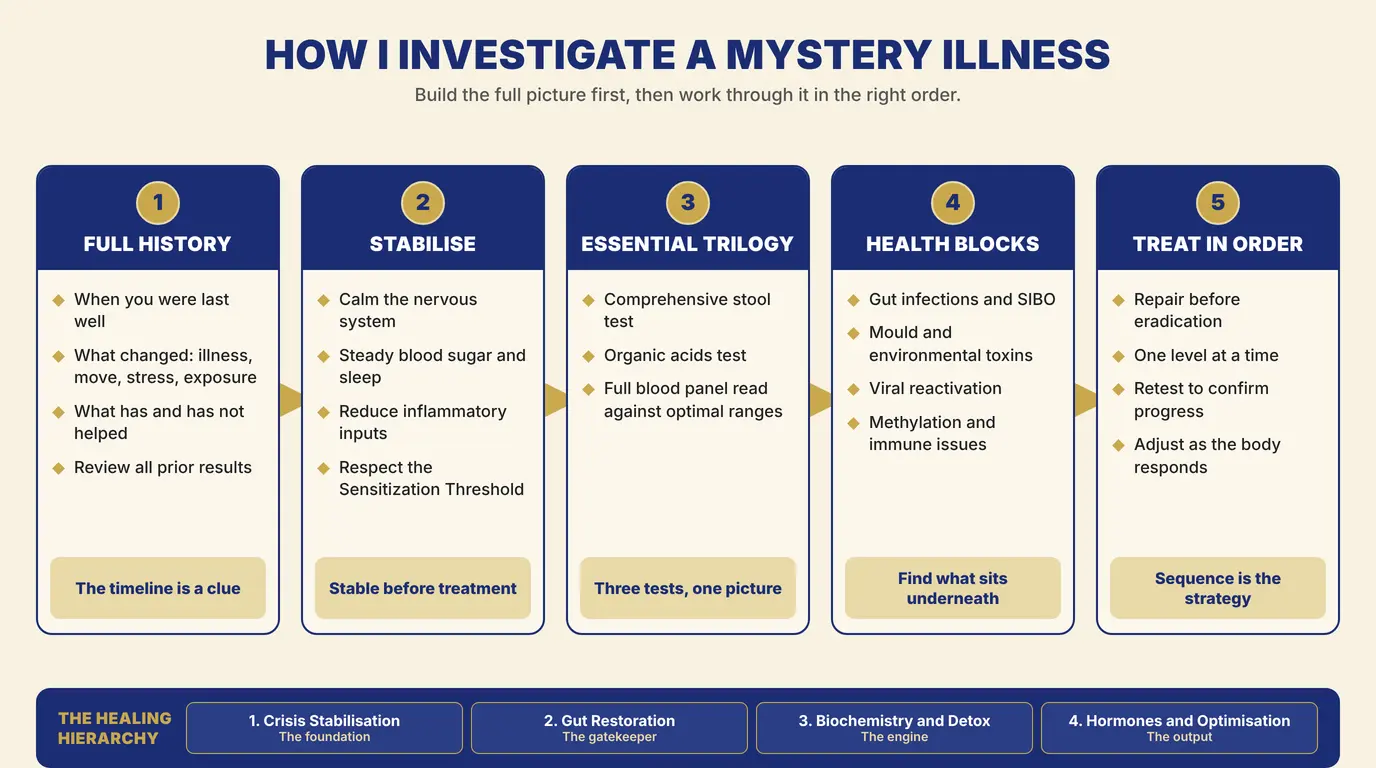
I do not start by guessing at a diagnosis. I start by building the full picture, then working through it in order.
- The whole history. When you were last well, what changed, and what has and has not helped. The timeline often tells me more than any single test result.
- Your current stability. If your nervous system is in overdrive, your sleep is broken or you react to almost everything, we stabilise first. Pushing treatment into a sensitised system is one of the main reasons people get worse. I call this the Sensitization Threshold.
- The Essential Trilogy. A comprehensive stool test, an organic acids test and a full blood panel read against optimal ranges. Together they show what is happening in the gut, at the cellular level and across your organs, and they routinely find what years of routine bloods missed.
- Health Blocks. Gut infections, mould and environmental toxins, viral reactivation, methylation bottlenecks and immune dysregulation that sit underneath the symptoms. Where the history points to them, we test for them specifically.
- The right order. Each driver is addressed in the sequence of the Healing Hierarchy, so the work you do in one stage holds instead of unravelling in the next.
The sequence matters more than any single treatment. Most people with a mystery illness have already tried good treatments. They were simply done in the wrong order, or before the foundations were ready to hold them.
What we often find
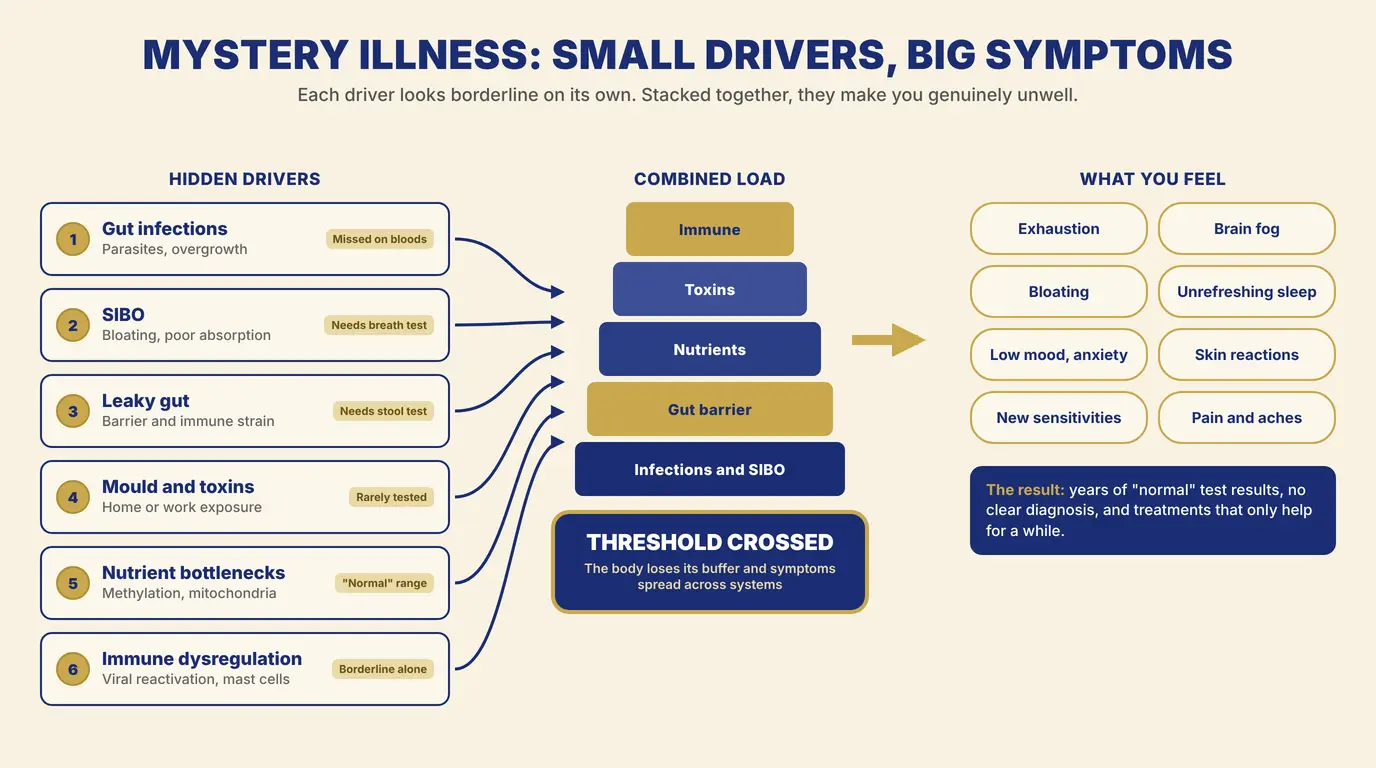
No two cases are the same, but the same drivers come up again and again in people who have been told nothing is wrong:
- Mould and biotoxin illness. Exposure in a home or workplace that triggers widespread inflammation and multi-system symptoms. See Mould illness and CIRS.
- Hidden gut infections. Parasites, bacterial overgrowth and SIBO that drive symptoms well beyond the gut, including fatigue, mood and skin issues.
- Mitochondrial dysfunction. Cells that cannot produce enough energy, which shows up as exhaustion, poor recovery and brain fog. See Chronic fatigue.
- Viral reactivation. Old infections such as Epstein-Barr that flare when the immune system is under strain.
- Methylation and nutrient bottlenecks. Problems that affect energy, mood, detoxification and hormones all at once.
- Immune dysregulation and mast cell activation. An immune system that over-reacts, causing new sensitivities, hives, flushing and flares.
Finding one of these is rarely the end of the story. The work is identifying which are present, how they interact, and which to address first.
Real cases
Molly was 25, a journalist who spent part of her working day on the road. She slept nine hours a night and still woke exhausted, and she had started to feel like she might fall asleep at the wheel. She had been diagnosed with idiopathic hypersomnia, which in plain terms means extreme sleepiness with no known cause. Her doctors were investigating narcolepsy, there was talk of taking away her driver’s licence, and she was about to start Modafinil, a stimulant medication, to keep her awake.
The sleepiness was only part of the picture. She had constant bloating and gas, burped after almost everything she ate, and her bowels swung between constipation and loose stools. She had chronic hay fever and took antihistamines most days, had blistering patches on her face, needed to urinate almost every hour, and had been on an antidepressant for two years. She had noticed her low moods tracked her bloating. Nobody had connected any of it to her fatigue.
Her blood tests were essentially normal, which is exactly why she had been told nothing was wrong. Her stool test told a very different story: a parasite called Dientamoeba fragilis, several opportunistic bacteria, very few beneficial bacteria, high zonulin showing a leaky gut lining, and low secretory IgA, a sign her gut’s immune defences were run down. A breath test confirmed SIBO, with both hydrogen and methane well above range. Her gut was inflamed, poorly absorbing what she ate, and producing a constant load that was flattening her energy, her sleep and her mood.
We worked in order. First, a reset diet to take the inflammatory load off, alongside nutrients to repair the gut lining and rebuild its defences, and active B vitamins to support methylation, a bottleneck that affects energy, mood and detoxification all at once. Within about five weeks she felt dramatically better, and she decided she no longer needed the sleep medication. Only once the gut was calmer did we clear the parasite, with a prescribed antiparasitic, followed by herbal antimicrobials for the bacterial overgrowth. Then we rebuilt, slowly reintroducing foods like cheese and legumes to see what her body could now tolerate.
Four months in, her retest showed the parasite was gone. Her energy and sleep were good, her bowels were regular, and she had weaned off her antidepressant over eight weeks. She never started the Modafinil. In her words, it completely changed her life. Idiopathic hypersomnia had never been the answer. It was a description of the problem, and the cause was in her gut all along.
A different picture: when the lungs are the symptom
Maureen was 57, a teacher who did yoga daily, cycled and gardened. By her own description she was fit, except for her lungs. Over 18 months she had been diagnosed with organising pneumonia, a form of interstitial lung disease, alongside psoriatic arthritis. She had recurrent Pseudomonas infections in her lungs, months of antibiotics, a preventative antibiotic three times a week, and a year and a half on steroids that left her shaky. She also had a strange fuzzy feeling in her throat, low energy and night sweats.
Nobody had looked at her gut. Her stool test found two parasites, Blastocystis and Dientamoeba fragilis, very low gut immune defences, a leaky gut lining, and few beneficial bacteria. Her breath test showed methane-dominant SIBO. Her lungs were the loudest symptom, but an overloaded immune system, driven from the gut, sat underneath them.
We started with an anti-inflammatory diet and support to repair the gut lining and the immune system. Years of infections, antibiotics and steroids had also left her methylation and detox pathways under strain, so we supported those too: active B vitamins for methylation, and NAC and glycine, two of the building blocks of glutathione, the body’s main detox antioxidant. NAC also helps thin and clear mucus from the lungs. A month later we began clearing the SIBO and parasites with herbal antimicrobials, and later a prescribed antiparasitic. Within four weeks her energy was up and she was sleeping well, and her flares came only when she strayed from the diet. Working alongside her specialists, she came off the preventative antibiotic and gradually reduced her steroids. About seven months in she was off steroids completely, and her lung function tests came back normal. Her follow-up scan showed her lungs largely clear apart from old scarring. Only then, at the top of the hierarchy, did we support her hormones and adrenal function to settle her night sweats. Her joint aches eased considerably, and she describes it as getting her life back.
In both cases, the specialists were right that something serious was going on. What was missing was anyone looking at what sat underneath it: the gut, the immune system, and the biochemistry, the methylation and detox pathways the body depends on to recover. We worked through each layer in order, with hormones last, and that is what allowed the results to hold.
FAQ
What is a mystery illness?
My tests are all normal. Could something still be wrong?
I have already spent a lot on tests. Will I need to redo them?
I have tried functional medicine before and it did not work. Why would this be different?
Do you work with patients outside Perth?
Where to start
If you want to understand the framework first, it is all in my book, The Healing Hierarchy, including the Stability Score self-assessment that shows where you sit right now.
I take on a limited number of new complex cases each year, by telehealth, across Australia and worldwide. We start by reviewing everything you have already had done, so none of that time or money is wasted.