Male Fertility Decline: Chemical Causes and Fixes
The Hidden Chemical Drivers Behind Falling Testosterone and Male Fertility
Male fertility decline is one of the most striking health trends of the past 50 years, and it has been building quietly for decades. Testosterone levels are falling, sperm counts are shrinking, and a growing body of research points to the same underlying cause: the chemicals we are exposed to every single day.
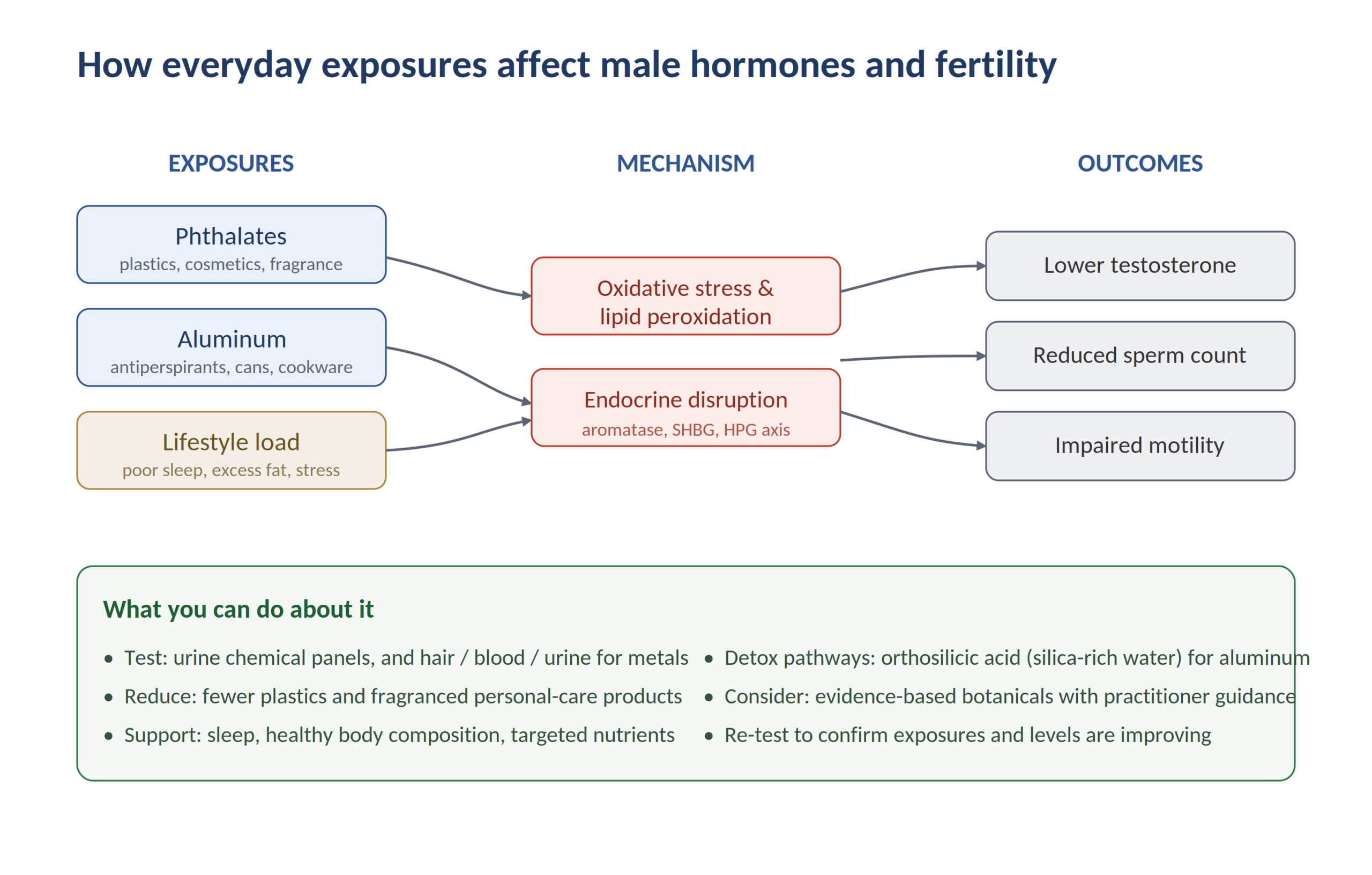
Everyday exposures converge on the same biology, and the same points offer places to intervene.
A natural Testosterone decline, made worse
Testosterone drops naturally with age in both sexes, but the effect is far more pronounced in men, who also lose free testosterone over time. Part of this is driven by sex hormone binding globulin, a protein that rises with age and binds up testosterone so the body can’t use it. Conditions like hypothyroidism and liver disease, along with certain nutritional factors, accelerate that rise.
This matters well beyond libido. Testosterone supports cardiovascular health, blood sugar control, lean muscle, bone strength, and metabolic rate. In men it also drives sperm development directly. So a testosterone decline often means a decline in sperm quality and motility too.
Many ordinary factors add to the load: diabetes, obesity, excess alcohol, and a long list of common medications from statins to SSRIs to beta blockers. Diet plays a role as well, with soy, trans fats, and chronic black licorice use all capable of nudging levels down.
The sperm count collapse
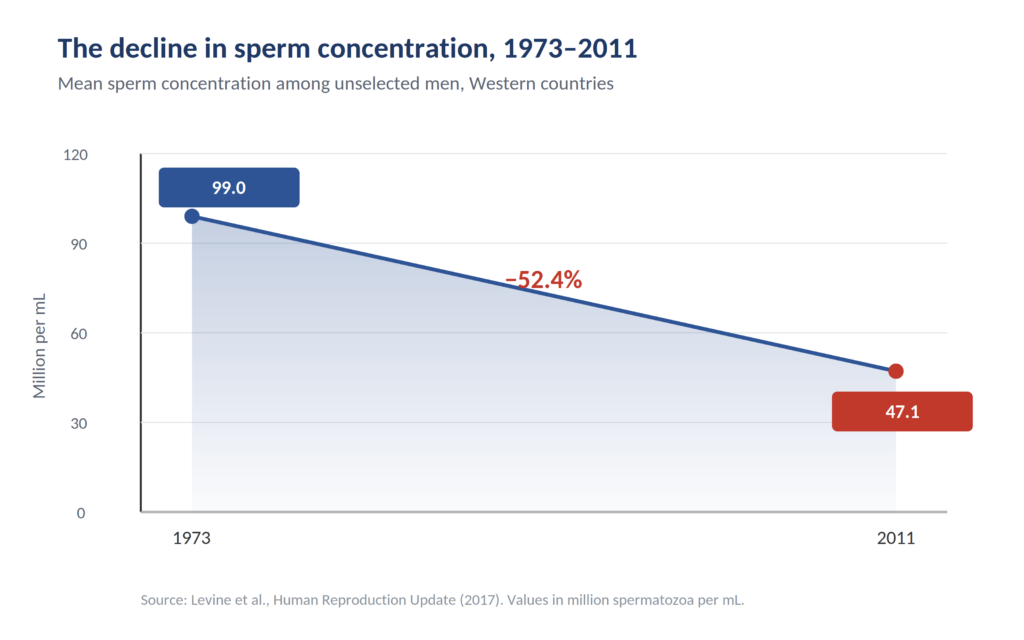
The most striking evidence comes from a 2022 meta-analysis led by Hagai Levine and Shanna Swan, published in Human Reproduction Update. Levine summarized the finding as a significant worldwide decline in sperm counts of over 50 percent across the past 46 years, a decline that has accelerated in recent years.[1] The earlier 2017 analysis from the same team had already documented that sperm concentration fell 52.4 percent between 1973 and 2011 among unselected men from Western countries, with no evidence of a leveling off.[2] This is a sustained, decades long trend, and it sits at the heart of the male fertility decline, mapping closely onto the rise of industrial and consumer chemical exposure.
Mean sperm concentration roughly halved over four decades of pooled Western data.
Why does the threshold matter? A landmark 1998 Lancet study of 430 first-pregnancy-planning couples found that the probability of conception rose with increasing sperm concentration up to 40 million per mL, but not beyond it, and pregnancy rates were markedly lower below that level (51.2 percent versus 65.0 percent).[3] The authors concluded that the WHO normal threshold of 20 million per mL should be used with caution, since some men above it may in fact be subfertile. In other words, the old “normal” line may be set too low.
Phthalates: the everyday endocrine disruptor
Phthalates are one of the clearest chemical contributors to male fertility decline, and they are everywhere: plastics, cosmetics, perfumes, flooring, adhesives, and even capsule coatings.
The population evidence is now substantial. A 2014 analysis of US NHANES data by Meeker and Ferguson, published in the Journal of Clinical Endocrinology and Metabolism, found an inverse relationship between urinary phthalate metabolites and serum testosterone across men, women, and children. The study noted evidence of declining testosterone trends in men in recent decades, alongside animal and human evidence that phthalates, found in plastics and personal care products, are linked to reduced androgen levels.[4] Earlier work by Hauser and colleagues at Harvard, drawing on men recruited from Massachusetts General Hospital, similarly explored phthalate exposure and altered reproductive hormones in adult men.[5]
A key and often overlooked source is personal care products. A 2005 study by Duty and colleagues in Environmental Health Perspectives found that men who used cologne or aftershave within 48 hours before urine collection had roughly double the median levels of monoethyl phthalate compared with non-users, and each additional product type used raised levels by about 33 percent.[6] Notably, monoethyl phthalate was detected in 100 percent of the men sampled.
Aluminum: the underrated exposure
Aluminium gets far less attention than plastics in discussions of male fertility decline, but the evidence is compelling. A 2017 rat study by Martinez and colleagues in Reproductive Toxicology dosed animals at human-relevant dietary levels over 60 days and found that aluminum decreased sperm count, daily sperm production, sperm motility, and normal sperm morphology, impaired testis histology, and increased oxidative stress and inflammation in the testis.[7] The authors concluded that even low concentrations of aluminum in the testes were sufficient to impair spermatogenesis and sperm quality.
In humans, a 2014 study by Klein and colleagues, also in Reproductive Toxicology, measured aluminum in the semen of 62 men and found that semen aluminum was high compared with other biological fluids, was significantly higher in men with low sperm counts, and was present directly within spermatozoa on cytological analysis.[8] The researchers proposed that increased exposure to environmental pollution may contribute to the decline in sperm quality seen in recent decades.
Aluminum’s mechanism appears to run largely through oxidative stress and lipid peroxidation, a damage process that affects cell membranes throughout the body, not just the testes. Common exposure sources include antiperspirants, aluminum cans, and aluminum cookware, making everyday contact difficult to avoid.
It is not all environmental: the levers you control
While chemical exposures are a major and underappreciated driver of male fertility decline, they sit on top of a foundation of everyday lifestyle factors that push testosterone in the same direction.
Sleep is the clearest example. In a controlled study at the University of Chicago, healthy young men restricted to five hours of sleep per night for a single week saw their daytime testosterone fall by 10 to 15 percent, an effect equivalent to aging 10 to 15 years.[9] Because most of a man’s daily testosterone is released during sleep, short or fragmented nights blunt production directly, and conditions like obstructive sleep apnea compound the problem. For men chasing hormonal recovery, protecting seven to nine hours of quality sleep is not optional background advice. It is one of the highest-yield interventions available.
Body composition is the next major lever. Excess fat tissue is hormonally active: it raises aromatase activity, the enzyme that converts testosterone into estrogen, and drives the systemic inflammation and insulin resistance that further suppress the hypothalamic-pituitary signaling behind testosterone production. A systematic review and meta-analysis found that weight loss reliably reverses obesity-associated low testosterone, with larger losses producing larger gains, and with the degree of weight reduction being the single best predictor of how much testosterone rises.[10] Resistance training and vigorous activity add to this both by lowering fat mass and by stimulating androgen production more directly.
Chronic stress works against all of it. Sustained high cortisol suppresses testosterone through competing signals at the level of the brain and testes, which is part of why poor sleep, overtraining, and relentless psychological pressure so often show up together with low readings. Nutrition matters too, though not always in the direction popular advice assumes. Adequate dietary fat supports testosterone production, and deficiencies in micronutrients like zinc and vitamin D are associated with lower levels, particularly in men who are already overweight or deficient. The practical message is that crash diets, chronic underfueling, and nutrient-poor eating can all quietly erode the same hormone the environmental exposures are attacking.
None of this replaces the chemical story. Rather, it means a man presenting with low testosterone or poor sperm parameters is usually dealing with several overlapping drivers at once, and the fastest progress tends to come from addressing the controllable lifestyle foundations at the same time as investigating and reducing toxic exposures.
What about the herbs?
No discussion of testosterone is complete without the botanicals that dominate the supplement aisle, and here the honest answer is that the evidence varies from one herb to the next, and that different herbs may work through different mechanisms. Some act primarily on testosterone itself, others more on libido, mood, or stress. It is worth taking them one at a time.
Tongkat ali (Eurycoma longifolia) has the strongest case. A systematic review and meta-analysis of randomized controlled trials found a significant increase in total testosterone among men taking standardized extracts, with the effect seen in both healthy volunteers and men with low testosterone.[11] The proposed mechanisms are plausible rather than magical: its active compounds appear to modestly inhibit aromatase and to help free bound testosterone from sex hormone binding globulin, and some trials also report reductions in cortisol, which fits its traditional use as a stress and vitality tonic. It is one of the better-evidenced botanicals in this space.
Fenugreek (Trigonella foenum-graecum) sits in the middle. A systematic review of single-herb trials identified fenugreek seed extract, alongside ashwagandha, as one of the few botanicals with genuinely positive effects on testosterone in men.[12] Results are not perfectly consistent across products and doses, and some of the strongest findings come from specific standardized extracts studied in resistance-training populations, but the signal is real and the safety profile is reassuring.
Tribulus terrestris is more nuanced. It is one of the most widely used testosterone and libido herbs in the world, with a long history in traditional practice, and users often report benefits for sex drive and vitality. What the controlled-trial evidence suggests is that these effects may run more through libido and sexual-function pathways than through a large direct rise in serum testosterone, and results across studies are mixed depending on the extract, dose, and population studied.[12] That does not mean it lacks value. It means tribulus is probably better understood as a libido and sexual-wellbeing support that may suit some men, rather than primarily as a testosterone-raising agent, and standardized extracts studied at adequate doses are where the more promising signals appear.
The sensible way to read all of this: a well-chosen botanical like tongkat ali or fenugreek may offer a modest, real nudge, particularly in men who are already low, but it works best as a complement to the foundations rather than a substitute for them. No herb will out-run poor sleep, excess body fat, chronic stress, or ongoing toxic exposure. And because supplement quality and dosing vary so widely, and because some products are adulterated with undeclared ingredients, these are best used with practitioner guidance rather than self-prescribed from the highest-ranked search result.
What you can do about male fertility decline
The encouraging part is that these exposures are testable and, to a degree, modifiable. Urine testing for environmental chemicals can reveal phthalate and other toxicant burdens, while hair, blood, and urine testing can flag elevated aluminum and heavy metals. For aluminum specifically, orthosilicic acid, a form of silicon found in silica-rich waters, has been studied as a route to support the body’s natural clearance, an approach explored in depth in the work of the late aluminum researcher Christopher Exley, who co-authored the human semen study above.[8]
Male fertility decline is not inevitable or mysterious. Much of it traces to modifiable, everyday chemical exposures, and testing for them and reducing what you can control is a clear, actionable path forward.

Jarrod Cooper – ND
Jarrod Cooper - ND is the founder of Advanced Functional Medicine Australia. He is a Naturopathic Doctor with extensive functional medicine training from leading practitioners in the USA and worldwide.
He is leading the way with advancements of functional medicine, clinically implementing worldwide best practices in Functional Medicine throughout Australia.
Jarrod consults in person from Perth, Western Australia and also online via Telehealth throughout Australia and worldwide.
If you are looking for personalised treatment, we highly recommend contacting Jarrod Cooper’s Advanced Functional Medicine clinic in Australia.
Related articles:

Fulvic Acid Benefits: A Functional Medicine Approach to Detoxification, Gut Health, and Cellular Energy
What is Fulvic Acid? Fulvic acid is a powerful organic compound found in soil, plants, and natural water sources. It is formed through the breakdown of organic matter by microorganisms, creating a bioavailable substance rich in trace minerals, antioxidants, and...